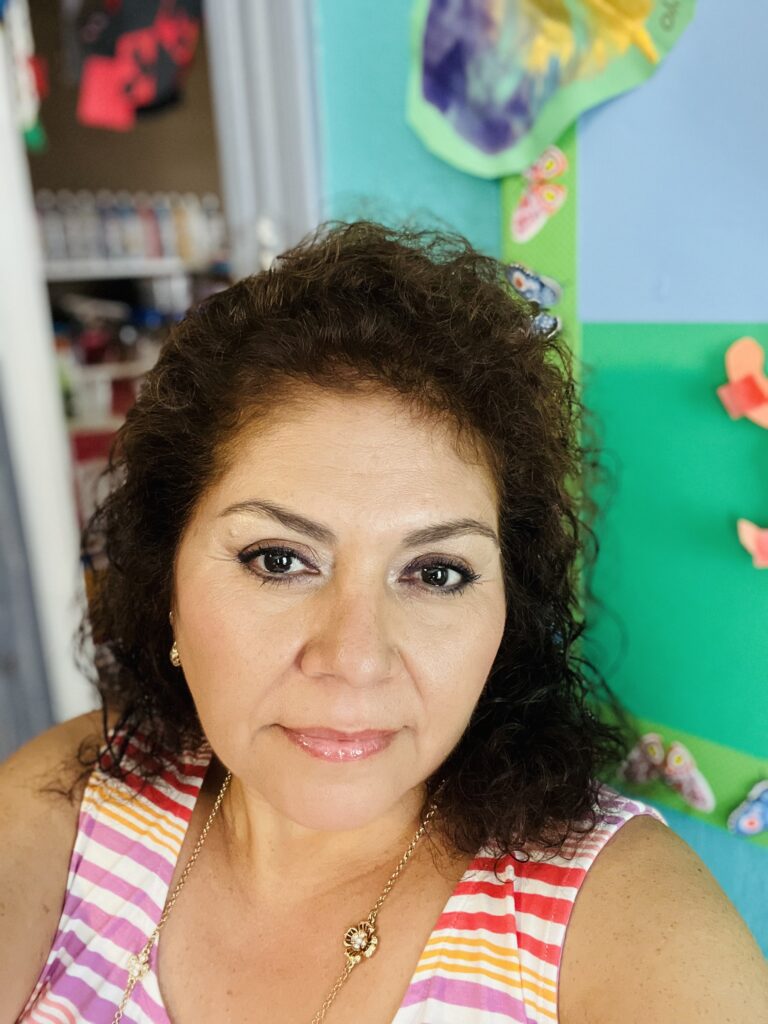
My name is Marisela Carpio, I am originally from Mexico and I have lived in the United States for more than 30 years, 5 of which I lived in the state of California where I got married and a year after getting married my husband and I moved to Wisconsin where my four children were born. One of my goals when I came to the United States was to obtain my GED so that I could eventually study Early Education since I always wanted to work in the field of education. It was not easy since initially I did not speak English well and many of the classes I took were in that language. In 2011 I obtained an associate degree in Early Childhood Education and in 2012, I opened my daycare: Marisela’s Family Daycare.
Years later, I was able to learn the language and that helped me earn my Bachelor’s degree in Human Services with a concentration in Early Childhood Education. My daycare currently has 4 stars according to the Young Star rating and my goal is to reach the maximum level of 5 stars. Although working with children can be very demanding, it is a career that brings many rewards: when you see a baby take their first steps, say their first words and then leave your daycare ready for kindergarten you know that all the effort was worth it. My next goals are to open a group daycare and also offer childcare related training.
¿Cómo puedo saber si su hijo está listo para dejar el pañal?
No hay una edad donde podamos decir que están preparados los niños para dejar de usar pañales, todos los niños son únicos, el desarrollo de cada niño no es el mismo la mayoría de ellos habrán desarrollado las habilidades físicas y cognitivas necesarias entre los 18 y los 24 meses.
Muchos padres deciden esperar hasta los dos años y medio cuando se puede confiar más en el control de la vejiga y también hay niños que no están listos hasta que tienen casi 3 años, o incluso 4.
Para ayudarte a determinar si ha llegado el momento, hemos elaborado una lista de las principales señales que indican que tu pequeño está listo. Recuerda que, si empiezas antes de que tu niño esté en realidad preparado, seguramente el proceso será más largo.
Antes de los 12 meses de edad, los niños no pueden controlar el pipí y popó, y muchos niños pequeños que muestran señales de que físicamente están listos para ir al baño solitos, no pueden controlarlo en realidad.
Incluso a los niños que pueden mantenerse secos en el día, les puede tomar más tiempo despertar para hacer pipí por las noches y muchos dejan de tener accidentes nocturnos hasta la edad de 5 años.
If your child attends child care, it is important to have an effective relationship with your child care provider so together you can work through this process, which will help a lot.
Your child is becoming independent and understands what it means to go to the bathroom like adults.
Physical signs
Has enough balance and coordination to walk, and even run steadily.
Urinates a lot at one time.
Has regular bowel movements and soft, well-formed stools.
Remains “dry” for periods of at least three to four hours (this indicates that the muscles of the bladder have developed enough to retain and store urine.
Behavorial signs
Is able to sit and remain in the same position for two to five minutes.
Can pull pants up and down on their own.
It bothers them to have a dirty diaper.
Tries to imitate adults when they go to the bathroom (wants to see you go to the bathroom, put on underwear, etc.).
Physically demonstrates that they really are using the restroom ( makes noises, bends over, or tells you).
They show that they like to be independent.
They are not a child who says “no” to everything.
They are proud of their achievements.
They don’t seem to resist learning to use the potty.
They are in a phase in which they are generally cooperative (does not always contradict or say “no” to everything).
Follows simple directions (for example, “sit on your potty”).
Understands the importance of keeping things in their place.
Has words (may be their own) for bowel movements and urine.
They know when they have to go to the bathroom (perceives the physical signals) and are able to tell you before doing it.
They can set a goal in their mind like going to the bathroom when they feel like it and remind themselves to do it.
What is the best way to change child care providers?
Finding child care for your baby is difficult the first time, but if you have to change child care, whether due to a move, concerns about care now, or for any other reason, it can bring a whole new set of challenges that can add up to the first things. On the other hand, your little one could transition so easily to his new caregiver that you forget your child hasn’t been there the whole time. It can be hard to know how your baby will respond to a new situation, but there are steps you can take to ease the transition, whether your little one arrives at the new place like a duck to water or needs to learn to swim again.
Give notice
If you’re moving, your little one probably already has an idea that some big changes are coming, but if you change child care providers for any other reason, the change may come as a surprise. If it may seem easier at the time to avoid the possibility of disturbing him before you need your little one, it probably won’t help the transition from having closure to saying goodbye to a place or people your little one has probably spent a significant amount of time with. Since your little one is quite young, and their sense of time is still developing, too many warnings may not help, but starting to talk to your little one about the change at least a few days in advance can give them a bit of reassurance. Time to adjust, and even time to start getting excited about the new child care provider. If you wait shortly before transition to talk to your little one about changing child care providers, don’t forget to let your current provider know you’re waiting to talk about it, so he or she doesn’t accidentally tell your little one first before you have the opportunity to do it yourself. Reading books and telling stories about characters facing big changes in their lives can also help give them a framework for thinking about change, especially if your little one is closer to one year of age.
General rehearsal
Before taking your little one to the new place, it may help to take him/her on a tour with you a few days before your little one starts there, so they won’t be completely unfamiliar with the area, or the provider, before their big first day.
Mark the occasion
On the last day with the old child care provider, consider doing something to make the day feel a little special, like sharing your little one’s favorite snack with the child care provider and any classmates or friends he/she might have there, and taking a walk through the daycare to say goodbye to the places and people that have been such a big part of his/her life for so long.
To be there
On your little one’s first day, if you can, plan your day so that you can stay there with him/her while they get used to the new environment. With you there to help him/her feel safe, your little one may be more willing to explore, to be social, and in doing so, to find things about the new place that he likes.
Send your little one prepared
If your child has a teddy bear or comfort object, its presence can help them feel comfortable in the new place. If your child has a favorite toy or object associated with the previous child care provider, and you are in a position where you feel comfortable asking the provider if your child can take it if you get a replacement for the daycare or provider, having a piece of your child’s old routine might help to adjust.
Be prepared
Even if your child is basically happy, secure, social and has never had a problem with child care before, there may be an adjustment period as your child gets used to the new daycare or child care provider. If your sweetie hasn’t started to settle into a routine after a week or two, consider talking with your provider about any issues your baby and the center are having getting along, or ways to improve the transition.
Courtesy of Precious Moment Child Care
Veracity • Innovation • Commitment • Positivism
Make ourselves known as a magazine for educators and share stories and reinforce our main teachings. Publicize small education businesses in the Milwaukee community Coming directly to homes and digital.